America...only here can one get rich and famous by threatening to run for President.
Could be an interesting ticket with either interchangeable blabber mouth running as President and the other a VP. Or more likely- neither- Why would they give up their fame mongering to stoop to public service?
But just imagine Tax and Spend Huckabee taking and spending your money...and then letting Palin explain it all to you...the possibilities are endless...Saturday Night Live secretly hopes this comes to pass.
Thursday, March 10, 2011
Wednesday, March 9, 2011
This Means War!
Look at the lovely chickens. Healthy, happy, and, well, sinister.
For weeks I have been trying to keep them in a large pen, which will become a small orchard by next Spring. They scratch up the weeds, fertilize, and eat pests. The orchard space adjoins the front door of their coop where we lock them in at night to protect them from varmints. I let them out into the 50ft by 16 ft orchard space during the day. I thought they would be happy to be in a grassy field with all the food and water they could want. But, alas, I underestimated the dark designs of this perfidious fowl!
One of the chicken's dirty little secrets is that they love to scratch freshly tilled soil...they especially love to scratch freshly tilled soil that has a thick layer of straw mulch upon it. They like, even more, to scratch freshly tilled and mulched soil that has tender young broccoli plants started in it. 72 broccoli plants actually. Well now about 52.
So, being beaten in my efforts to keep the chickens in a yard, I have had to do some refencing in order to keep the chickens OUT of the garden. Better to keep them out of the garden than in a cage no matter how large it is I guess is their philosophy.
The battle raged on this morning, amidst dark, cloudy skies, 40 degrees, and 30 mile an hour winds...(55 and sunny huh weatherman?). But I think I finally have won the battle. As soon as the project is complete and everything spruced up a bit, I'll post some pictures.
For weeks I have been trying to keep them in a large pen, which will become a small orchard by next Spring. They scratch up the weeds, fertilize, and eat pests. The orchard space adjoins the front door of their coop where we lock them in at night to protect them from varmints. I let them out into the 50ft by 16 ft orchard space during the day. I thought they would be happy to be in a grassy field with all the food and water they could want. But, alas, I underestimated the dark designs of this perfidious fowl!
One of the chicken's dirty little secrets is that they love to scratch freshly tilled soil...they especially love to scratch freshly tilled soil that has a thick layer of straw mulch upon it. They like, even more, to scratch freshly tilled and mulched soil that has tender young broccoli plants started in it. 72 broccoli plants actually. Well now about 52.
So, being beaten in my efforts to keep the chickens in a yard, I have had to do some refencing in order to keep the chickens OUT of the garden. Better to keep them out of the garden than in a cage no matter how large it is I guess is their philosophy.
The battle raged on this morning, amidst dark, cloudy skies, 40 degrees, and 30 mile an hour winds...(55 and sunny huh weatherman?). But I think I finally have won the battle. As soon as the project is complete and everything spruced up a bit, I'll post some pictures.
Monday, March 7, 2011
America Is...
a land of people that burn leaves every fall and then...
buy dirt at their garden center every spring.
DO NOT BURN YOUR LEAVES! Pile them up to compost every fall then by the time you think you need to buy dirt at the nursery, you'll have a pile of dirt right there where you left them.
a land of people that buy low quality necessities from a box store because it is cheap...
and end up buying one every year because it wears out instead of investing in products they only have to buy once in a lifetime.
a land of people that buy a new car with thousands of dollars of credit...
Instead of spending $300 cash to fix the old car one more time...
a land of people that buy pesticide, fertilizer, and seed from one big corporation whose name starts with capital M...
Instead of pulling weeds themselves...
making their own fertilizer...
or buying seeds from an independant and local supplier or saving seeds themselves.
buy dirt at their garden center every spring.
DO NOT BURN YOUR LEAVES! Pile them up to compost every fall then by the time you think you need to buy dirt at the nursery, you'll have a pile of dirt right there where you left them.
a land of people that buy low quality necessities from a box store because it is cheap...
and end up buying one every year because it wears out instead of investing in products they only have to buy once in a lifetime.
a land of people that buy a new car with thousands of dollars of credit...
Instead of spending $300 cash to fix the old car one more time...
a land of people that buy pesticide, fertilizer, and seed from one big corporation whose name starts with capital M...
Instead of pulling weeds themselves...
making their own fertilizer...
or buying seeds from an independant and local supplier or saving seeds themselves.
Part 4: The American Farmer's Revolution
Revolution: late 14c., originally of celestial bodies, from O.Fr. revolution, from L.L. revolutionem (nom. revolutio) "a revolving," from L. revolutus, pp. of revolvere ...
Okay, the whole idea behind revolution is that one segment of society (those not in power) feels that its only recourse is to seize the power with the vision of doing society some good. Most armed revolutions, however, wind up with the seizing of power with good intentions but quickly turning into powers for revenge. This does not describe the kind of revolution America needs. America needs a revolution where the rebelling segment of society is great in number, peaceful, and forward thinking. America needs The American Farmer's Revolution.
If you are calling for, or hopefully waiting for, a revolution in our country that will overturn the present abusive, earth killing, manipulative, fear-mongering, profit taking, exploitative power then you have already missed it. It has been working in fits and starts since the early 1960s. What is remarkable to me is that it has slowly built momentum over the last 5 decades and is now actually affecting public policy. The proliferation of locally grown farmer's markets (there's one in little ole Perryville Arkanasas population 1,750), community supported agriculture gardens, and cottage industries in many small communities shows that the consumers in America want something different than what the big box stores and our federal government can provide. They want relationships with the people that are growing their food. They want to know who to complain to if the tomatoes go bad a little too soon. They want to know that their produce is grown without chemicals and that the land is just as good or better than last year. They want to know that fossil fuels, plastics, and illegal labor were not used in the production of their food. And they want their dollars staying in the community and not being spread to foreign countries or financial exchanges in New York, Chicago, or internationally. You see, as Wendell Berry has stated, politics is no longer the question; economics is the fulcrum upon which this revolution is perched.
Recent public policy changes in Arkansas show that this "revolutionary" segment of our society is having an impact. Arkansas, one of the few solvent states in the union recently passed a bill to allow cottage industries to sell direct to the customer from their farms or at farmer's markets unimpeded. This includes bread and other baked goods, soap, jams and jellies, and produce. The bill was rushed to the governor who signed without hesitation because otherwise, local economies would suffer if the bill did not pass into law. Thank you Arkansas Health Department and Governor Beebee (Democrat) and several Arkansas State representatives democrat and republican alike!
http://www.arkleg.state.ar.us/assembly/2011/2011R/Acts/Act72.pdf
The seemingly monlithic antagonism for small scale community based economies is being worn away, not with angry protestations, but with reasonable, measured pressure being applied by the local communities themselves. The conclusion, finally, of this study of the new revolution is a manifesto for the American Farmer Revolution.
Preamble: Whereas, the security of the American People is now most threatened by its inability to meet its own basic needs without dependence on corporations acting as "people", subsidies by our federal government, and legislation restricting commerce at the community level, we resolve to secede from any arrangements requiring interference from said corporations and government agencies by:
Personal Articles:
1. Land is our greatest assett. No action should be taken or no neglect tolerated that reduces the value of such land. It must be kept in its natural state as much as possible with natural processes and amendments.
2. Living within our means- debt is bad. debt is bad. debt is bad. It eats into the financial efficiency of your operation. Do not take the bait of easy farm loans for equipment. As controversial as it is to say : "if a farm has to borrow to buy another tractor and it already has debt in other sectors of the enterprise then it is growing too big too fast.
3. Reducing our means- do not get too big too fast. Live less expensively, not cheaper.
4. Invest in real property that will either hold or increase its value. This property must also be such that it contributes to the prior articles. This includes land but even more importantly, buy reliable tools that require little maintenance even if they are more expensive on the front end. It will save money in the long term.
5. Reduce your tax obligations this will happen by reducing your income which can be done by living within your means.
Economic Articles:
1. Buy Local- even if a piece of lumber or that leaky faucet is a few dollars more at your local hardware store, buy it! Remember, they are locked into and competing with a MEGA-economy that would love to squeeze them out of business. Besides, you'll use less gas by shopping locally and develop a local community that the big-boxes can not do regardless of what their commercials would like you to think.
2. Sell Local- only take your excess produce or goods outside of your local community. Decide what local is for you. With us it's a 45 mile radius.
3. Raise Prices honestly- Don't pull the ole Walmart - greater quantity lower prices if the quality is not there.
4. Do Not Compete directly with another farmer in your community-unless you are competing with quality. Grow something different, grow it better, develop a different skill, find a niche that fills a need. Competition is the tool of the enemy in this case. In the name of competition many local business have closed their doors. Competition gives the mega-corps an excuse to play dirty.
5. Create Interdependence Within the Community - do not be afraid to ask for help; do not be afraid to offer help.
6. Quality! Quality! Quality!- We can't preach "buy local, nuy organic" if our produce is not at the highest standard of freshness and appearance. Rather, miss a sale instead of taking sub par produce to the market.
7. Develop Farming Efficiencies that do NOT require fossil fuels- compost, use a shovel instead of a tiller, mulch with leaves rather than burning them.
8. Compost everything you can! The ultimate in recycling, this keeps your land's value.
9. Give - volunteer at the market you attend, give away your unsold or excess produce to a food pantry, take a loaf of bread to a neighbor.
10. Do not believe everything you hear or see in commercials. The product is generally substandard especially if it is cheaper. In fact, do not believe anything you hear or see in commercials. "Good looking blonde women will not faun over you if you drink their beer or drive their car. If you can get three more of something by buying now - it means "this is cheap junk and you don't really need it."
11. Do not break the law to prove a point or to challenge a practice you think is unfair. The time for lawbreakers is past. The revolution has too much momentum. We are now in the marketing stage of our little struggle. We are gaining ground. Law-breakers lend a stigma to law abiding small-holders that we can not afford to struggle against. Remember, we are the good guys, act like the good guys. The growing momentum can not be lost if we are to continue to affect change in public policy concerning the restricitions our governments have put on small farm operations (in the name of food safety).
We are winning many battles across the nation when it comes to the freedom all small-holders should have to buy and sell the products they want, without interference from agencies and restrictive laws that should not apply to the local community. In Arkansas we have many more freedoms than some states and yet there is still work to do. Next time, perhaps, we can tackle raw milk and why there is only one independent dairy left in the state.
Vive la revolution!
Sunday, March 6, 2011
Boyd's Big List of His Favorite Tools
I thought I would take a break from my rantings about revolution, while I gather my thoughts for the finale - Part 4, and share with you my list of favorite tools. I do not get any kind of payment for these endorsements (not yet anyway).
10 Bushel Cart bought on sale for $69.99 (regular $119.00) at Tractor Supply Co. We carry everything in this - firewood, leaves, soil, lumber, fence rolls, T-posts, tools, 50lb bags of feed, manure.
Electrician's Pliers - not sure where they came from but they cut fence, tie wire, cattle panels, and are awesome when doing electrical work.
These next two are my little babies. Ryobi 18v drill and 5 and 1/4 inch circular saw. I work them to death and have never had a problem. $110.00 for the two (on-sale in one kit) at Home Depot.
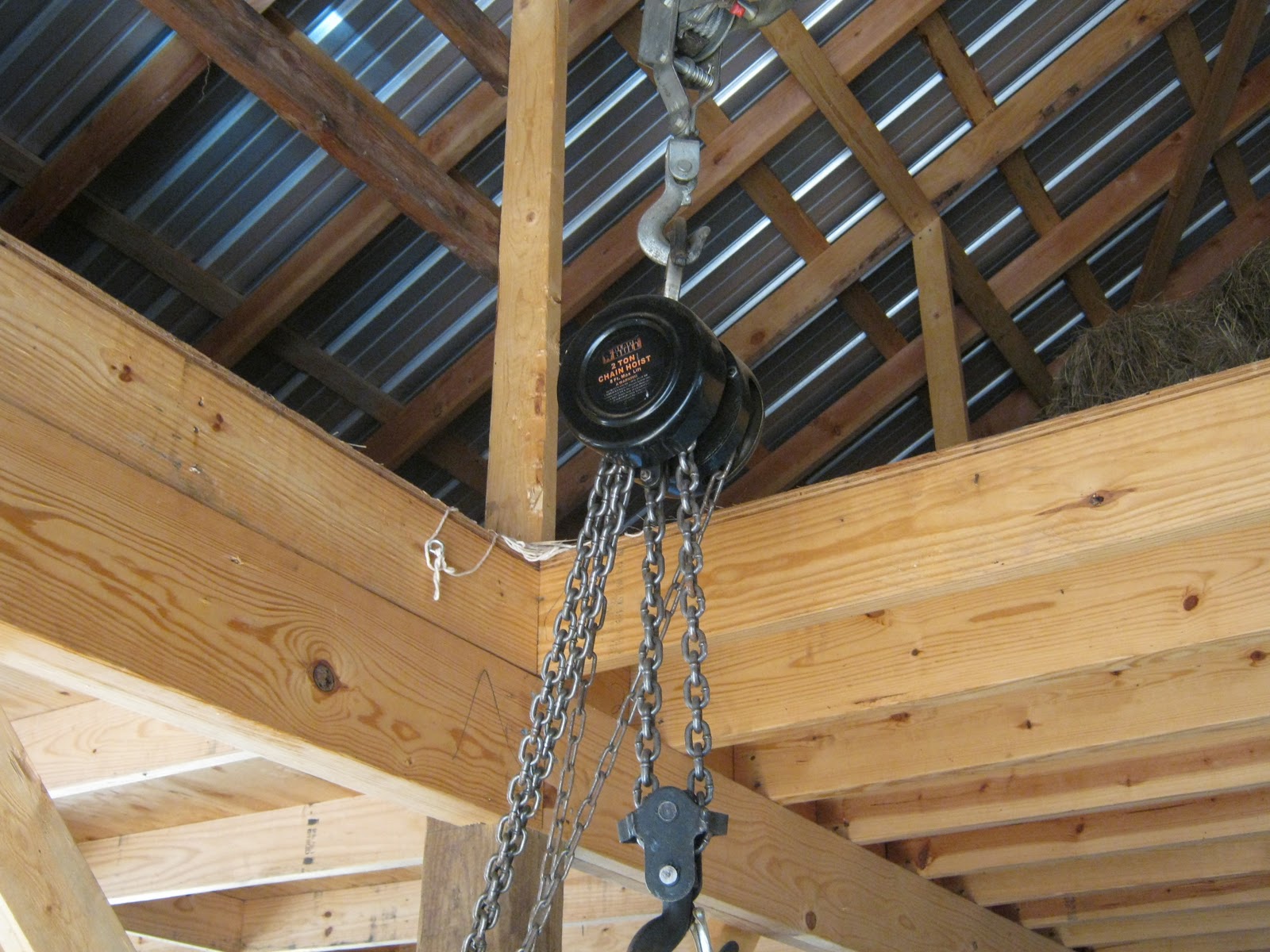
2 and 1/2 ton block and tackle ($75.00 from Sportsman's Guide) is a life saver when lifting air conditioners into the barn loft for the winter and the wood stove for the summer. Also makes butchering larger animals a breeze. I can hang them and raise them to eye-height - no stooping or reaching!
My fleet of workhorse chainsaws. All Poulan - a 20", one 18", and my favorite of all, the easy starting, 16" friend. Altogether we cut enough firewood for our homestead on less than 2 gallons of mixed gas.
Fiskars post hole diggers ($29.99 at Lowe's many years ago). All metal and the crossed-spades allow me to dig 4ft deep if I want. No rust no bending or sharpening. Heavy, but its heft helps me drive it into the ground. I always look for Fiskars brands for shovels, picks, etc.
Garden Spade made by Corona ($5.00 at Tractor Supply). This spade and two others have been lost and found many times, left in the rain and snow, used improperly to dig out all sorts of things- no rust, no bends.
Broad-fork ($110.00 from Johnny's Seeds)- this tool is a throw back to pre-machine gardens and was designed and endorsed by Elliot Coleman. This tool has allowed us to start planting much earlier as we have not had to till our garden for the first time in 10 years!
Rabbit Water-er ($7.00 at Tractor Supply) - better than the ones you get from your co-op. Filtered at the nozzle and the easy filling cap make it great. The best thing, though, is the way it mounts to the wire. No hooks/ The easy thumbscrew and plate design will attache to any kind of fencing material from hardware cloth to 2" chicken wire, or field fence if I wanted to.
Gate latch ($7.00 from Tractor Supply) - easy to install, easy to operated, we use these on every stall we build.
Little Philips Screwdriver - I learned this trick from my brother, Roland, who is much smarter than I. When clipping fence to T-posts, don't bother with fence pliers to secure the clips. Simply hook the small loop of the clip over the fence, wrap the clip around the Tpost, and then position the large hook of the clip under the fence. Slip the screwdriver through the large loop and then spin the screwdriver away from you and around the strand of fence. Oi-la! The clip is tight and secure.
The Big Blue Nail was a gift from my parents one Christmas - yes it was wrapped - yes I guessed what it was. This tool has been used for everything- rolling logs, digging out big rocks, prying warped boards straight before nailing, stretching field fence, and as a lever to pull the power-steering pump over on its bracket to tighten the alternator belt on my old truck.
The Walking Stick to its right is what I use to herd our geese around. Hold it to the right of the gaggle and they all move left, hold it to the left and they move right. It is also used to bust ice out of water buckets every winter and poking holes in our garden rows for transplants.
10 Bushel Cart bought on sale for $69.99 (regular $119.00) at Tractor Supply Co. We carry everything in this - firewood, leaves, soil, lumber, fence rolls, T-posts, tools, 50lb bags of feed, manure.
Electrician's Pliers - not sure where they came from but they cut fence, tie wire, cattle panels, and are awesome when doing electrical work.
These next two are my little babies. Ryobi 18v drill and 5 and 1/4 inch circular saw. I work them to death and have never had a problem. $110.00 for the two (on-sale in one kit) at Home Depot.
2 and 1/2 ton block and tackle ($75.00 from Sportsman's Guide) is a life saver when lifting air conditioners into the barn loft for the winter and the wood stove for the summer. Also makes butchering larger animals a breeze. I can hang them and raise them to eye-height - no stooping or reaching!
My fleet of workhorse chainsaws. All Poulan - a 20", one 18", and my favorite of all, the easy starting, 16" friend. Altogether we cut enough firewood for our homestead on less than 2 gallons of mixed gas.
Fiskars post hole diggers ($29.99 at Lowe's many years ago). All metal and the crossed-spades allow me to dig 4ft deep if I want. No rust no bending or sharpening. Heavy, but its heft helps me drive it into the ground. I always look for Fiskars brands for shovels, picks, etc.
Garden Spade made by Corona ($5.00 at Tractor Supply). This spade and two others have been lost and found many times, left in the rain and snow, used improperly to dig out all sorts of things- no rust, no bends.
Broad-fork ($110.00 from Johnny's Seeds)- this tool is a throw back to pre-machine gardens and was designed and endorsed by Elliot Coleman. This tool has allowed us to start planting much earlier as we have not had to till our garden for the first time in 10 years!
Rabbit Water-er ($7.00 at Tractor Supply) - better than the ones you get from your co-op. Filtered at the nozzle and the easy filling cap make it great. The best thing, though, is the way it mounts to the wire. No hooks/ The easy thumbscrew and plate design will attache to any kind of fencing material from hardware cloth to 2" chicken wire, or field fence if I wanted to.
Gate latch ($7.00 from Tractor Supply) - easy to install, easy to operated, we use these on every stall we build.
Little Philips Screwdriver - I learned this trick from my brother, Roland, who is much smarter than I. When clipping fence to T-posts, don't bother with fence pliers to secure the clips. Simply hook the small loop of the clip over the fence, wrap the clip around the Tpost, and then position the large hook of the clip under the fence. Slip the screwdriver through the large loop and then spin the screwdriver away from you and around the strand of fence. Oi-la! The clip is tight and secure.
The Big Blue Nail was a gift from my parents one Christmas - yes it was wrapped - yes I guessed what it was. This tool has been used for everything- rolling logs, digging out big rocks, prying warped boards straight before nailing, stretching field fence, and as a lever to pull the power-steering pump over on its bracket to tighten the alternator belt on my old truck.
The Walking Stick to its right is what I use to herd our geese around. Hold it to the right of the gaggle and they all move left, hold it to the left and they move right. It is also used to bust ice out of water buckets every winter and poking holes in our garden rows for transplants.
Tuesday, March 1, 2011
Don't Start the Revolution Without Me (part3)
Part 3 starts off with a picture of our most effective weapon in this New American Revolution. A simple, accurately priced, healthy, and locally produced loaf of bread. I could have easily used a picture of a tomato from our garden, or a bunch of asparagus spears, or blueberries, garlic, lettuce, or a free-range chicken, or really anything sold at our local farmer's market.
In Part 2 I discussed one option for overthrowing the so called "free-market" and return the power of buying, selling, and profit taking to the local community. This first option required catastrophe and suffering to start it, and catastrophe and suffering would follow its completion. Again, as explained in part 1, the military, or armed response to the US Government would not be effective in that, there is no military power or desire to use it if it were there, in the local communities and this kind of rebellion would be directed towards an basically dysfunctional and bewildered government that is not the real enemy. Attacking the USDA or the FDA or the Health Department in our states would be like skinning the tail of a badger. The real danger, the real enemy would remain and redouble its attack. No, we must, kill the enemy, not by bloodshed, but by caging it and slowly starving it to death. This real enemy is the so-called, global Free-Market.
As discussed earlier, if the people's economy is controlled then their politics are moot. They really become nothing more than water-cooler or chat page fodder - entertainment really. Glenn Beck needs to eat. So do I. Whether I agree with Fox News or not, is not the issue. The real issue is this. How can I expect to live in a time of crisis if this monstrous infrastructure fails? The answer is, at once, simple and difficult. Ideologically it is simple. Charitable, self-sufficiency. The building of a local community where raw materials are processed, marketed, and sold within the community and only the excess of our labors are sold to an outside market or community. There are pictures of this all over America and more and more examples are evident every day. Our on-line farmer's market allows us to produce groceries and sell them directly to our customers, who by the virtue of a face to face transaction when the market meets, become neighbors and slowly they become friends. The farmer is able to ask whatever price his produce is worth in back-aching labor, infrastructure, time, and fuel costs. The customer agrees to this price for whatever reason. If the customer refuses to pay that price, then the farmer must improve the value of the product or lower the price. The difference between this kind of transaction and the one happening in the "global-free-market" economy is that the farmer and the customer are in complete control. In the "free-market" the farmer has no choice, the customer has no real choice, the conglomerate has the power.
I must, at this point, add that I have neglected to mention one of the more important benefits of the local economy I am describing and that is the low-impact the business transaction has on the earth and the high impact it has on the "free-market". In a local economy, I never have to fuel up an 18 wheeler and drive it across the country. I never have to tear up the land my crops grow in with heavy machinery (that must be fueled); I rarely ever have to rely on the "free-market" to produce what we grow. Our produce is healthier because of the way it is grown and the timeliness of its delivery. Our customers know this and they also know that choosing to buy locally, they are too, protecting the earth, the ancient tradition of the small farmer, and they are keeping their money within their community and thus, their control.
There are many more examples and if this article , has piqued your interest I would suggest, for further reading and enlightenment, Wendell Berry's What Matters? Economics for a Renewed Commonwealth, Counterpoint Berkely Press, 2010, from which the quotes used in this article were gathered.
Now I conclude my fragmented ranting by stating that by developing robust local communities where most, if not all, of our needs can be found within the community is really the only viable way to overthrow the present power of this "free-market" economy (that is not free).
Think about what would happen if this global "free-market", for whatever reason shut down tomorrow with no hope for recovery. Where would you buy your next pair of shoes? Unless your local community has a functioning cobbler, you would eventually go around barefoot. What if your car ran out of gas and there was no longer any real expectation that the station will be visited by a tanker for the next 3 months? How would you get to work? What would you do with yourself when electricity is no longer available? No TV, No Fox News, no gaming, no cell phones...What if you never developed a local trusting economy where most of your needs could be met right around your home? Would you trust your neighbors? This is why catastrophe or an armed overthrow is undesirable. Few of us would survive.
But what if, just what if, we built local infrastructure now, as we are able, to prepare for when this "global-free-market" economy does fail, as it is likely to do? I would think that the revolutionaries in this case would be heroes as we would be able to help our neighbors in need. With a burgeoning local economy, with real tradesmen selling real products and services, the unemployed in our communities would find the desire to learn skills that are not beyond their scope, useless college degrees would no longer be desired because there would be no "upward mobility" possible. People would feel useful and they would be.
In part 4 (the final act I promise) I try to get practical by addressing what you can do to join this New American Revolution - a revolution I call The American Farmer's Revolution.
In Part 2 I discussed one option for overthrowing the so called "free-market" and return the power of buying, selling, and profit taking to the local community. This first option required catastrophe and suffering to start it, and catastrophe and suffering would follow its completion. Again, as explained in part 1, the military, or armed response to the US Government would not be effective in that, there is no military power or desire to use it if it were there, in the local communities and this kind of rebellion would be directed towards an basically dysfunctional and bewildered government that is not the real enemy. Attacking the USDA or the FDA or the Health Department in our states would be like skinning the tail of a badger. The real danger, the real enemy would remain and redouble its attack. No, we must, kill the enemy, not by bloodshed, but by caging it and slowly starving it to death. This real enemy is the so-called, global Free-Market.
As discussed earlier, if the people's economy is controlled then their politics are moot. They really become nothing more than water-cooler or chat page fodder - entertainment really. Glenn Beck needs to eat. So do I. Whether I agree with Fox News or not, is not the issue. The real issue is this. How can I expect to live in a time of crisis if this monstrous infrastructure fails? The answer is, at once, simple and difficult. Ideologically it is simple. Charitable, self-sufficiency. The building of a local community where raw materials are processed, marketed, and sold within the community and only the excess of our labors are sold to an outside market or community. There are pictures of this all over America and more and more examples are evident every day. Our on-line farmer's market allows us to produce groceries and sell them directly to our customers, who by the virtue of a face to face transaction when the market meets, become neighbors and slowly they become friends. The farmer is able to ask whatever price his produce is worth in back-aching labor, infrastructure, time, and fuel costs. The customer agrees to this price for whatever reason. If the customer refuses to pay that price, then the farmer must improve the value of the product or lower the price. The difference between this kind of transaction and the one happening in the "global-free-market" economy is that the farmer and the customer are in complete control. In the "free-market" the farmer has no choice, the customer has no real choice, the conglomerate has the power.
I must, at this point, add that I have neglected to mention one of the more important benefits of the local economy I am describing and that is the low-impact the business transaction has on the earth and the high impact it has on the "free-market". In a local economy, I never have to fuel up an 18 wheeler and drive it across the country. I never have to tear up the land my crops grow in with heavy machinery (that must be fueled); I rarely ever have to rely on the "free-market" to produce what we grow. Our produce is healthier because of the way it is grown and the timeliness of its delivery. Our customers know this and they also know that choosing to buy locally, they are too, protecting the earth, the ancient tradition of the small farmer, and they are keeping their money within their community and thus, their control.
There are many more examples and if this article , has piqued your interest I would suggest, for further reading and enlightenment, Wendell Berry's What Matters? Economics for a Renewed Commonwealth, Counterpoint Berkely Press, 2010, from which the quotes used in this article were gathered.
Now I conclude my fragmented ranting by stating that by developing robust local communities where most, if not all, of our needs can be found within the community is really the only viable way to overthrow the present power of this "free-market" economy (that is not free).
Think about what would happen if this global "free-market", for whatever reason shut down tomorrow with no hope for recovery. Where would you buy your next pair of shoes? Unless your local community has a functioning cobbler, you would eventually go around barefoot. What if your car ran out of gas and there was no longer any real expectation that the station will be visited by a tanker for the next 3 months? How would you get to work? What would you do with yourself when electricity is no longer available? No TV, No Fox News, no gaming, no cell phones...What if you never developed a local trusting economy where most of your needs could be met right around your home? Would you trust your neighbors? This is why catastrophe or an armed overthrow is undesirable. Few of us would survive.
But what if, just what if, we built local infrastructure now, as we are able, to prepare for when this "global-free-market" economy does fail, as it is likely to do? I would think that the revolutionaries in this case would be heroes as we would be able to help our neighbors in need. With a burgeoning local economy, with real tradesmen selling real products and services, the unemployed in our communities would find the desire to learn skills that are not beyond their scope, useless college degrees would no longer be desired because there would be no "upward mobility" possible. People would feel useful and they would be.
In part 4 (the final act I promise) I try to get practical by addressing what you can do to join this New American Revolution - a revolution I call The American Farmer's Revolution.
Don't Start the Revolution Without Me (part2)
My choice of pictures to top off the various parts of this 4 part series on the New American Revolution was by design. In Part 1 I used a scene from the French Revolution. This kind of armed rebellion some are calling for is never good and usually ends with the revolutionaries and government alike visiting the Glorious Barber of Paris. I will admit, that once it is over things are much quieter and those that survive get left alone for the most part but still the suffering is great and the cause never realizes its goal of freedom. It simply trades one form of tyranny for another.
For Part 2 I use the colorful, flower-child, 60s-ish Revolution logo you see above. Why? because the revolution is happening now - but it is not happening with weapons. It is a back-to-the-earth revolution; a moving away from the Wall Street, Madison Avenue, plastic society we have become. What is remarkable is that this revolution was started, however imperfectly, in the 60s.
Wendell Berry, in 2009 essay entitled, Simple Solutions, Package Deals... describes this nouveau 60s ideology like this.
"Given the growing demand for local food, and the increasing numbers of farmer's markets and Community Supported Agriculture farms, it is becoming possible to imagine the development of local farm and food economies in which communities and localities produce, process, market, and consume local farm products, marketing any surplus to outside demand [or the non-local buyers]."
The basis of this New American Revolution, that is enduring in fits and starts from our predecessors, the hippies my parents hated, is a rebellion against having our food choices made for us by Monsanto, the FDA, the USDA, and foreign countries. If we think the White House, the House of Representatives, or the Senate is representing us then we are naive. If we think they are controlling us, well, then we are simply paranoid and we are pointing that paranoia at the wrong parties. We are without representation on a national level (we have to face this fact) and we are being controlled in at least two ways by large corporations, investment companies, marketing agencies, and foreign governments who willingly allow corporations to exploit their own people for the sake of their own false economies.
Here's how it works: The goods we produce are sold to outside interests, tomatoes for example. A farmer, in order to sell his tomatoes to Wal-Mart must have the produce and his farm inspected by the USDA. An expense the farmer is held to bear. Because "free market" rules require WalMart to buy at the lowest price possible and because the farmer needs cash flow, he accepts this price. At this point the farmer is separated from the larger economy as a seller; he then becomes a buyer because he must spend with other outside interests to buy the things he needs. Meanwhile, the conglomerate processes and sells the tomatoes at a much higher price to the consumer. In this picture of the "free-market" only one party is free. That is the conglomerate. The burden of producing the tomato is solely on the farmer. In this example, WalMart is the money making middle man.
Most of the laws in place, ostensibly, to protect food safety, really only make it difficult, if not impossible for a small acreage farmer to compete in this so called, free market. It thus either drives the farmer out of business or requires him to become a conglomerate in order to take part in the "Free Market".
This is how we are controlled. We are controlled by the "Free-Market", which is not free, and which is made to function by the large corporations controlling the pricing, marketing, and selling of the produce. This happened mainly because in the 1980s, Ronald Reagan, relaxed the anti-trust laws which allowed mega corporations, Wal-Mart, Monsanto, and many others, to operate (take over) the markets almost unhindered. Now, 50 years later, America has ceded its freedom to produce, sell, and enjoy their profits, to strangers - the conglomerates, who do not really care about my local needs but operate solely for the increasing of profits. This disconnect between the local producer and his community and the customer allows the conglomerate to use up the small farmer resource, requiring him to quit or get bigger, while the corporate monster realizes all the profits. This, then is the real enemy. Our federal government is simply a tool adeptly used by the corporations to keep this false economy going the way it is. Do you not think it odd that one large company now controls most of the seed, pesticide, and herbicide? Is it just me or does the fact that Monsanto controls most of the world's food supply? Does it bother you that essentially 3 major corporations own the market of processing Monsanto's food for us? It should.
Again Wendell Berry: " If you can control a people's economy, you don't need to worry about its politics; its politics have become irrelevant. If you control a people's choices as to whether or not they will work, where they will work, what they will do, and how well they do it, and what they will eat and wear, and the genetic makeup of their crops and animals, and what they will do for amusement, then why should your worry about freedom of speech? In a totalitarian economy, any "political liberties" that the people might retain would simply cease to matter. If, as is often the case already, nobody can be elected who is not wealthy, and if nobody can be wealthy without dependence on the corporate economy, then what is your vote worth? The citizen thus becomes an economic subject." (1994)
This. then, is the enemy of this New American Revolution. Our vote means nothing, Democrats and Republicans, and Independents, and Tea-Partiers (whatever they are) all have to eat and buy clothing, and drive their cars to work.
There are really only two options to help drive down this false-mega-"free market" economy. Either of which will return the economic power to the local communities.
Firstly, a total disaster on the order of the US purposely devaluing the dollar, or a major catastrophic natural event that wipes out the conglomerates ability to transport, sell, or process our food and clothing. Say on the order of major crop losses nationwide, long-term electrical failure, or fuel shortages of massive proportions; any of these would remove the ability of the small farmer to sell his product outside of his own community.
The second option, and more preferable, in my opinion is what we will discuss in Don't Start the Revolution Without Me (part 3)
For Part 2 I use the colorful, flower-child, 60s-ish Revolution logo you see above. Why? because the revolution is happening now - but it is not happening with weapons. It is a back-to-the-earth revolution; a moving away from the Wall Street, Madison Avenue, plastic society we have become. What is remarkable is that this revolution was started, however imperfectly, in the 60s.
Wendell Berry, in 2009 essay entitled, Simple Solutions, Package Deals... describes this nouveau 60s ideology like this.
"Given the growing demand for local food, and the increasing numbers of farmer's markets and Community Supported Agriculture farms, it is becoming possible to imagine the development of local farm and food economies in which communities and localities produce, process, market, and consume local farm products, marketing any surplus to outside demand [or the non-local buyers]."
The basis of this New American Revolution, that is enduring in fits and starts from our predecessors, the hippies my parents hated, is a rebellion against having our food choices made for us by Monsanto, the FDA, the USDA, and foreign countries. If we think the White House, the House of Representatives, or the Senate is representing us then we are naive. If we think they are controlling us, well, then we are simply paranoid and we are pointing that paranoia at the wrong parties. We are without representation on a national level (we have to face this fact) and we are being controlled in at least two ways by large corporations, investment companies, marketing agencies, and foreign governments who willingly allow corporations to exploit their own people for the sake of their own false economies.
Here's how it works: The goods we produce are sold to outside interests, tomatoes for example. A farmer, in order to sell his tomatoes to Wal-Mart must have the produce and his farm inspected by the USDA. An expense the farmer is held to bear. Because "free market" rules require WalMart to buy at the lowest price possible and because the farmer needs cash flow, he accepts this price. At this point the farmer is separated from the larger economy as a seller; he then becomes a buyer because he must spend with other outside interests to buy the things he needs. Meanwhile, the conglomerate processes and sells the tomatoes at a much higher price to the consumer. In this picture of the "free-market" only one party is free. That is the conglomerate. The burden of producing the tomato is solely on the farmer. In this example, WalMart is the money making middle man.
Most of the laws in place, ostensibly, to protect food safety, really only make it difficult, if not impossible for a small acreage farmer to compete in this so called, free market. It thus either drives the farmer out of business or requires him to become a conglomerate in order to take part in the "Free Market".
This is how we are controlled. We are controlled by the "Free-Market", which is not free, and which is made to function by the large corporations controlling the pricing, marketing, and selling of the produce. This happened mainly because in the 1980s, Ronald Reagan, relaxed the anti-trust laws which allowed mega corporations, Wal-Mart, Monsanto, and many others, to operate (take over) the markets almost unhindered. Now, 50 years later, America has ceded its freedom to produce, sell, and enjoy their profits, to strangers - the conglomerates, who do not really care about my local needs but operate solely for the increasing of profits. This disconnect between the local producer and his community and the customer allows the conglomerate to use up the small farmer resource, requiring him to quit or get bigger, while the corporate monster realizes all the profits. This, then is the real enemy. Our federal government is simply a tool adeptly used by the corporations to keep this false economy going the way it is. Do you not think it odd that one large company now controls most of the seed, pesticide, and herbicide? Is it just me or does the fact that Monsanto controls most of the world's food supply? Does it bother you that essentially 3 major corporations own the market of processing Monsanto's food for us? It should.
Again Wendell Berry: " If you can control a people's economy, you don't need to worry about its politics; its politics have become irrelevant. If you control a people's choices as to whether or not they will work, where they will work, what they will do, and how well they do it, and what they will eat and wear, and the genetic makeup of their crops and animals, and what they will do for amusement, then why should your worry about freedom of speech? In a totalitarian economy, any "political liberties" that the people might retain would simply cease to matter. If, as is often the case already, nobody can be elected who is not wealthy, and if nobody can be wealthy without dependence on the corporate economy, then what is your vote worth? The citizen thus becomes an economic subject." (1994)
This. then, is the enemy of this New American Revolution. Our vote means nothing, Democrats and Republicans, and Independents, and Tea-Partiers (whatever they are) all have to eat and buy clothing, and drive their cars to work.
There are really only two options to help drive down this false-mega-"free market" economy. Either of which will return the economic power to the local communities.
Firstly, a total disaster on the order of the US purposely devaluing the dollar, or a major catastrophic natural event that wipes out the conglomerates ability to transport, sell, or process our food and clothing. Say on the order of major crop losses nationwide, long-term electrical failure, or fuel shortages of massive proportions; any of these would remove the ability of the small farmer to sell his product outside of his own community.
The second option, and more preferable, in my opinion is what we will discuss in Don't Start the Revolution Without Me (part 3)
Subscribe to:
Posts (Atom)