Pages

Showing posts with label Gardening Tips. Show all posts

Sunday, July 14, 2013

I Had A Feeling - Deep Down In My Gut

Shamrock and Thistle Farm, 5:30 AM
Somewhere in the middle of Blast Furnace, Arkansas


Up early is the only way during this time of year. Work until 10:00 AM. This is when the too-close Sun breaks the top of the trees lining the eastern border of the property and begins to try the resolve of those humans and animals still living, or mostly living.

I was able to plant 60 feet of green beans in our slowly-being-renovated garden. I meant to take some pictures to post but as the sun cleared the trees, the batteries overheated; chemicals raised in increasing amounts of agitation, boiled over, rendering the electronic device obsolete. It occurs to me that, back in the day, when picture taken relied on mechanics, optics, and the inverse square law, batteries were not required. The chores were done and some staging for some night time projects completed, I surveyed the farm just to check up on some things. The cross garden is coming into shape and the tomato plant located there, which had given us our first tomato of the year, picked too soon as it always is, had turned two more smaller fruit that had turned a deep salmon color and felt soft to the squeeze. I almost picked them - almost, but remembering the tartness of the first I decided, against something in my belly telling me to go ahead, to give them one more hot day to ripen fully. I went inside, got some things in the house accomplished, a big breakfast gulleted, the nap time she comes and goes, and then, the time being fulfilled, I go outside to pick our tomatoes which should be very ripe and ready to eat.


Apparently something got to it before I did. An eyewitness described a Female, Black and White barred, rose come, slightly pink legs leaving the scene while they were closing the gate of the garden. A warrant was issued for the apprehension of the alleged perpetrator. It will be served tonight. A trial will be commenced. Due to the egregious nature of the crime, the proceedings will be without a jury and I will be the judge. The hen will get a fair trial, then I will incarcerate her in solitary confinement for a period no less than 3 days. If this hen doesn't lay 2 eggs during the 3 day sentence, she will be executed at dawn on the fourth day...

Thursday, July 4, 2013

VietCong Grass, Miniature Roses, and PBA Backsliding

 Wow! There is Oregano in there! It took almost two hours to pull the Vietcong grass out of this 12 SqFt patch of Oregano. I found several dozens of Dutch Iris Bulb we had planted 5 years ago that had never been thinned. They are being moved to another area in the garden tonight. The VC grass was quite the challenge. I call it Vietcong grass because its roots burrow deep into the earth and criss cross in a network of interconnecting tunnels. And just when you think you have won, you look back and ask why did I spend so much time and energy reclaiming such a tiny patch of real estate. And then you realize that you didn't win - it's more like a tie. Eventually it will be back and you'll have to do it all over again.
 These are miniature roses that Martha Stewart says aren't worth the trouble to transplant. These are the kinds of roses you give to  someone else as gifts. You'll see them in grocery stores from time to time. Ostensibly, there purpose is to die shortly after the holiday for which you bought them is over, becoming root bound, if they are not root bound already when you bought them. To transplant these we used a technique described by Michael Pollan in his book Second Nature a Gardener's Education. Digging the hole twice as large as you think it needs to be, filling it with water, removing the plant, not so gently from the pot it was in, and then tossing it, again not so gently into the hole, covering with rich loose soil, and then watering again. Here Patt has mulched with leaves after removing VC grass. Through out the spring they have bloomed at least twice. Patt has dead-headed them in the hopes of more flowers in a couple of weeks.

 The gargantuan plan behind and to the left of the sunflower speaks to the fertility of our soil in the cross garden. A whole lotta plant but not a whole lot of tomatoes just yet. This variety is the Carbon tomato which will be a deep purplish, almost black color when they are ripe. The cross garden used to be part of the back yard, tree stumps, VC grass, and rocks. Now, after years of amending the soil with organic matter, digging, and planting, it has become the most fertile patch of land on the farm.

The sunflowers, as a side note, were planted by the many species of birds that feed from a nearby bird feeder.

After a week of mowing with a push mower and weed-eating the  thigh high grass and weeds that are goats are incapable of keeping up with we now have a clear path from the house to the barn. There's Disle, my truck off to the right. I told Patt that we are now officially Arkansas Rednecks in that we have 4 vehicles, only one of the running the way it should, and I just mowed around my farm truck, because, Disle won't start.

Farming Makes You Stupid Addendum - The Muscadines

One of the smartest men I know, Lester, was relating a conversation he had with his good buddy Ry one Saturday afternoon concerning his struggles with keeping weeds out of his Muscadine  beds.

"Ry, I've tried everything. Can't get a lawn mower in between the plants. A hoe goes too deep and it cuts some of the roots; the weed-eater slices up the trunk of the vines, or I end up clipping some of them off. Don't want to spray weed killer because if I put too much or get too close it deadens the plant," bemoans Lester, "you've got muscadine vines, what do you do?"

In one of those eternal moments where actions communicate more fully than words ever could, Ry gets down on one knee next to one of the vines and within 10 seconds has pulled every weed from around the plant, by hand.

The fact that Lester let everyone know this happened is a testament to his humility and to his understanding that modernity, while sometimes extremely nice in its convenience, is not always the best way of doing things.

This is another illustration of how our dependence on machinery to do our farming for us has made us dumber. Now, in the interest of full disclosure, I've been mowing and weed-eating all week - since another friend of mine fixed my Craftsman Lawnmower in exchange for two loaves of Patt's bread, and I finally figured out how to load string in the weed-eater.

I preach and preach on this blog to NOT use fossil fuels - or at least I encourage others to do as we have done and eliminate them wherever possible - in their small scale farming. From time to time, however, we find ourselves falling behind for various odd reasons and the only way to catch up is to crank up a gas powered machine. I guess that is the difference. In our case we use it only when necessary. In Lester's case, the machine has just always been there and, in a way, the machine trains us to use it to the point we sometimes forget the great joy and simplicity of simply stooping over and pulling the weed.

Wednesday, June 26, 2013

Pig Tractor Part 3

 After only three weeks on this patch, the pigs had tilled it all up, we moved them to the next area and we planted tomatoes and Mississippi Silver Crowder peas, mulching heavily with old hay the morning after our rainstorm described in "Struck By Lightning". Between the rows of peas on the right I have a bed prepared for a planting of garlic come October.


 After only two weeks (the pigs are now HOGS and becoming more efficient at pulling up the weeds) the second patch of garden space has been cleared. Now its our turn to lay out the beds and plant with something that will add nitrogen to the soil and something that will loosen it a little.


 Here are Squeal and Grunt in their final paddock in our garden area. This over grown area has already been obliterated by their tough jowls and muscular snouts. The picture was taken after only two days on the patch. Next up for them - they will do the same in our pasture areas where we will throw down grass and clover seed for the rest of the year.


This, in an unrelated note, is our asparagus bed (three 30 foot rows) all "ferned out". It has finally been weeded and mulched. Nothing else to do here until the first heavy frost kills the ferns. Then we snip them off at ground level, fertilize the area, lay down a heavy blanket of leaves, and then place the ferns on top to hold it all in place. Then, God willing, by the time the Irises bloom out next spring we will be up to our ears in asparagus!

Saturday, June 22, 2013

Struck By Lightning

I started writing "Hot and Dry and Humid" in my farm journal (which I hope to turn into Boyd's New Arkansas Farmer's Almanac someday), what seems like a year ago. Progress on the farm has been occurring in fits and starts, go out, work a little until I just start feeling a little dizzy, then back inside for a rest. Hot and Dry and Humid. Every day. Eventually I stopped writing it out and opted for just the acronym, "HDH". Once I tired of this exercise I start just making the "ditto" marks, then, this being too much to bear, day after long hot day, the entries are blank. So I really can't tell the last time we got any significant rain.

Today I worked a few projects until the heat got too bearable - 9AM Arkansas Time, then I reverted back the strategy of keeping the projects short and doable, so I could run back inside, shirt soaked, in front of a fan, reading my favorite book of all time until I fall into a catnap, then back outside for another little project.

The last project I started, out of desperation, was to set up a sprinkler in the portion of the garden where our tomatoes and cow peas are planted. My hope, in addition to watering the plants, was to soften the ground which has become hard and cracked, so I could do some easy weeding early tomorrow morning.

I performed my annual ritual of soaking my self with the sprinkler until I could get the range and direction set to only water what I needed watered and then did the evening chores. Hark! What do I hear? Is that the rumble of what we used to call thunder? And the flashing on the horizon? Could that be, what was it we called those bright flashes that immediately preceded this thunder. Lightning, that's it. No rain though, just the preamble. Kind of like a movie trailer that promises a laughing in the aisles comedy but fails to deliver once your in the middle of it.

The air did cool down a bit and the breeze picked up making it tolerable, at least, to be outside. So I decided to help Patt weed the strawberries in the Cross Garden. Then...it started to rain! Rain! Glorious Rain!

I continued weeding. Patt called the dogs and ran in the house. I thought she would have asked me to come in the house with her saying something like, "You'll get hit by lightning". To which I would have replied, "Then I will die doing something I like to do...or I'll survive and be one of those savants that can read people's minds..."

When she returned, wearing her straw hat and work gloves, I smiled inside. You know, like the feeling you get when you know that everything is going to be okay? By the time she got back out to the garden my white woven cotton work shirt was soaked through. I was dead sexy! Kind of like Colin Firth as Mr. Darcy coming up out of the lake sexy. Funny that Patt did not mention it.

Any way, we got the strawberries, rosemary, and thyme beds weeded. I ran to the barn to turn the sprinkler off while Patt went inside. The cool air refreshed me as I entered. Patt showed me the radar of West Arkansas out of Russelville. There was one storm on the screen. A small one, directly over our farm.

I told Patt that what happened made all the heat worth it. She said, "well I wouldn't go that far."

Now a nice dinner of beef in a wine reduction and swiss chard with raisins and pine nuts.

Monday, May 27, 2013

Operation Pig Tractor Part Two

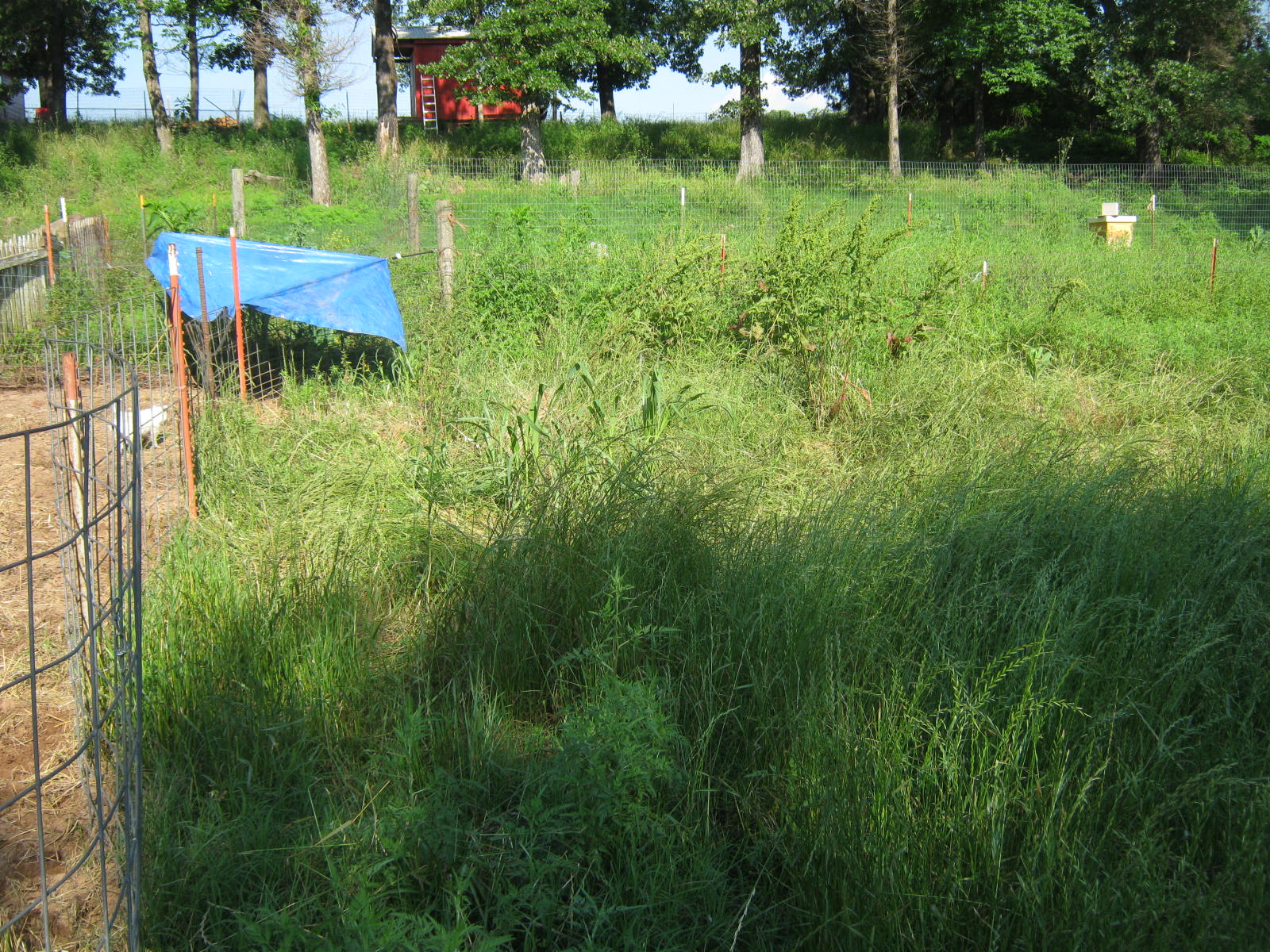
 The above picture shows what the garden looks like after two years of our being away from the farm. Tired of hand digging in the heat we decided to put our pigs to good use, now that they are large enough to keep inside cattle panels.

 After 7 days locked into a patch of the garden, the above picture demonstrates the thoroughness and efficiency of the pig as a tractor. The large clumps of grass still standing have actually been rooted up so they are easily lifted out of the ground. They are simply waiting to wither up and die. Most of the grass was eaten by the hogs but that which remained was collected and tossed into the walk way as seen below.


 Now we have a bare patch of garden to set rows in and a mulched walkway. By simply flip-flopping the fence, we easily created a new section of garden for them to work in. They were turned out into this new patch this morning and wasted no time in eating down the tall grass and digging the clumps out by the roots.
This next patch is a bit larger and more overgrown than the previous one, but I suspect in about two weeks we will have another bare patch ready to plant. We will then repeat the process further down the garden. By mid summer we should have a weeded, tilled, and fertilized garden plot.

Tonight we will be planting cow-peas in this first patch, tomorrow we will plant tomatoes. In the next patch, once it is ready, we may plant our fall crops such as butternut squash and pumpkins.

Saturday, May 18, 2013

Operation Pig Tractor

Since moving back to the farm in February, Patt and I have been debating, with either of us waffling from PBA to OSA (Petroleum Based Agriculture and Old Solar Agriculture) off and on. We land on the OSA side when the weather is cool, the rain is regular, and we aren't coming down with some kind of disease from some of the city folk we have to mingle with from time to time. (Just kidding city folk!) We are tempted by the PBA when the weather is hot, dry, the ground is compacted, and through some series of events, the weeds grow thicker and taller, and faster than we can pull them out.

Today we put our emergency response plan into place today. Facing 90 degree weather and high humidity for the next week or so and a garden that is out of control -


We went to Defcon 4 and put Operation Pig Tractor into play.

The first stage of Pig Tractor starts with a single tpost marking one corner of the new bed space. It is set about 2 feet away from our asparagus beds- this was by design as you will see. eventually this 2 ft gap will be heavily mulched and become a walkway between our established beds and our new asparagus bed which will be planted next spring.


Step two involved releasing our pigs, Squeal and Grunt, into our corner pasture where they have been in a semi-mobile pen, which is the subject of a prior post. The following video shows their reaction to this new freedom.


They both were running around all crazy like Jon Pinette at a Chinese Buffet.
http://www.youtube.com/watch?v=TdwuiyO7hOU


Once their mobile pen was dismantled we moved it into the garden. The key here is to protect the beds we already have established while routing the pigs around them into their new pen.


These were protected by a chute we built.

This routed them between the asparagus bed along the future walk way. They entered through a gap we left in the pen. Once inside we closed the gap with a small piece of scrap cattle panel to make a gate.


Here are Squeal and Grunt in their new temporary home - a 32x50 foot rectangle that will be mowed, tilled, and fertilized, by them and then laid out in at least 3 50 foot rows and planted in tomatoes and cow peas by us. This fall, when the weather cools off again, I'll dig three new asparagus beds to be ready for planting in the Spring of 2014 - if ever we live that long.


This is OSA. Old Solar Agriculture. The slow way. The hard way, yes, but no petroleum was used in the construction of the pen or in the mowing, tilling, or planting that will come. When this spot is completely rooted up, we will open the back corner of the pen to allow them access to the back half of our over-grown garden which will be fenced off from the planted portion, by swinging the panels into place.

Now, getting the pigs into the pen was not uneventful. Once the pen was built and the chute put into place, we still had to get them from bottom corner pasture into the garden. Ronny and I planned it out to the minute detail. Patt would keep their attention with a bucket of feed and attempt to lure them into the garden gate and the opening of the chute, while Ronny and I with an intricate moving wall of cattle panels, gates, and hay bales would keep them from escaping into the large pasture. On this 90 degree day, we did not want to chase pigs. As it turns out, the pigs did escape, but eventually, after Ronny and I stopped panicking, the pigs found Patt with the feed and we slowly coaxed them into the chute by calmly standing in their way if the went the wrong direction, not pressing them too closely, and, in essence, convincing the pigs that going into the chute was their idea, and it was a good one.


Wednesday, May 15, 2013

Farming Makes You Stupid (PBA versus OSA)


I probably need to make two distinctions prior in order to set up the following study of how farming relates to intelligence and to minimize any offenses that may be taken.

For the balance of this article I will refer to two very different kinds of farming. The first type is what I will call Old Solar Agriculture (OSA). This description was originally coined, I think, by Wendell Berry, the Kentucky farmer and poet. It is the slow, local way to farm. Little or no petroleum is used in production or product delivery. Soil is amended through the work of animals and human hands. Grasses are converted by the animals into manures which are composted, locally, and spread with a shovel or the occasional use of a tractor of some sort. Weeds are pulled by hand tools; pests are controlled with beneficial insects or by hand. The manures and weeding renovate the soil which is warmed by the sun and watered by the rain, freshly fallen, or captured in barrels. The sun, the rain, the animals, and the farmer’s hands are the major players in growing nutrients the slow way, the renewable way, the least impactful way. Product delivery is local, minimizing the petroleum used in transporting to local markets to an old farm truck or even a new SUV. Minimal food miles is the key. Food travelling thirty miles once or twice a week uses less petroleum and has a lower impact on the earth than food travelling across the country or around the world daily. This is OSA – Old Solar Agriculture.
The other kind of farming I will refer to is modern, Petroleum Based Agriculture (PBA). This kind of farming is the diametric opposite of OSA. The “success” of this kind of agriculture is dependent on fossil fuels to till, plant, spray, fertilize, harvest, and deliver nutrients to a much wider customer base across a state, country or continent. I’ve heard it said, that 90% of all asparagus sold in the US comes from South America. Food miles pile up, fuels are burned to plant, harvest, refrigerate, and deliver produce, impacting our planet by using up fuels we are creating now and affecting the environment through its exhaust. This is large scale, petroleum/machine based agriculture that is performed with minimal or no input from people and animals. This is PBA – Petroleum Based Agriculture.

The second distinction is more grammatical in nature. I use the word Stupid a lot in the article to follow. The way I use it must not be mistaken for an insult. The word is used more directionally than an actual state of intelligence. When I placed the title “Farming Makes You Stupid” I had two agendas that I feel, to be fair to you, I need to disclose. First, the controversial title is designed to pique interest, cause discussion, and perhaps, in some cases, insult. The second is to demonstrate how, since the introduction of petroleum based agriculture as early as World War I, has reversed the course of human “common sense”. I will attempt to flesh this out as I proceed. The main thesis being, By Relying on Machinery and Fossil Fuels for Nutrient Production, farmers have lost knowledge, once gained by trial and error and common sense, and found a dependence on science that seems to work to get food to the customer. As more and more machines take the place of humans on the farm, more and more humans leave to be consumers, who do not need to think about or figure out how to get food on their table. With fewer humans and animals doing the work, those humans left to running the machines no longer “think” about farming – they think solely on the machines. And, I think, this applies to other areas of life. As the physical and mental requirements have changed, especially in this 21st century, we have not had to “think” about what to do to achieve a desired result, and then physically do it. We are, in some ways, losing eternal knowledge and, as a result, we are getting stupider. I will now try to illustrate specific examples of how “Farming Makes You Stupid”.
Some of the stupidest people I’ve ever met were those I talked with during our time in Nebraska. Nebraska is mostly rural; mostly agricultural. In my experience, farmers had always had the most “common sense”, or better yet, “wisdom”. Taking what they knew about nature, seeing what needed to be done to achieve a certain goal or yield, and physically, with their hands, making it happen.
My grandfather, Alva M. Ober, was quite the renaissance man. A farmer, famous for his Suffolk sheep operation in Champaign County Ohio, winner of countless Champion, Grand Champion, and Showmanship ribbons from the county fair, an auctioneer, singer of bluegrass tunes on the local radio station (Here Rattler Here was his favorite tune to whistle while working), a big name in the county; truly one of the best known of farmers in the area. Throughout the short time I knew him he remade himself, learned new things, and excelled in both. He left the sheep business one day and decided to take his International 444 tractor equipped with a box grater, and fashioned an large oval in one of his alfalfa fields. Round and round he went until a fully formed, banked, horse racing track was created. I helped him build a horse barn at one end of the track – a barn built by hand with just a few helpers. When joining boards, he pried and bent, by hand every warped plank into shape and then single handedly, without the use of an air-compressed nail gun; just a hammer and nails, attached them into place. If a gap appeared from a warped plank that did not set into place, there was no talk of caulking, foam filled insulation, or patches. The board was removed and then tossed aside for a new one, or the reshaping, by hand, was tried again.
He had three ponds in the field behind his house, stocked with fish. It was here that I learned how to talk to the fish. He would cast a line and leave the bail open on the reel as he walked around the small pond, gently tugging at the line to give him enough slack to make the circuit, and every single time, he had a crappie or perch on the hook by the time he got back round to me, standing on the bank amazed.
He started raising quail one year. He must have had over 100 baby chicks in an incubator he built himself, by hand, with hand saw, triangle square, and the ever-present hammer and nails.
“Are you going to eat them?” I asked.
“Eat them!? Eat my babies? I’m going to turn them loose in the field out back.” He exclaimed.
Sure enough, when they were big enough to fend for themselves, he turned them loose into the field behind the house where his fish ponds were located. At the time, this field had an orchard, tall grass, and a checkerboard planting of young pines no more that a foot tall. Pines that he planted himself, by hand, digging every hole with a shovel and pick. Now that field is a large pine forest. I now know that upon entering the race horse phase of his life, he decided to return the unused portion of his land to the wild.
Grandpa eventually became quite a big name in the Sulky Racing community in central Ohio. When his horse barn burned down due to the misbehavior of a crack-head cousin of mine, he rebuilt it, by hand, hammer and nail. Grandpa died in a Columbus Ohio hospital after getting kicked in the chest by one of his race horses. The kick didn’t end his life. The technology laden hospital did. Grandpa’s farm was the closest thing I’ve known to Old Solar Agriculture though he would not have described it thus. To him, there was only one way – the old way; the slow way.
One day I brought algebra homework to his house. I was spending the weekend to help him on some new thing he was trying on his farm. I showed him my math problem – one of those lengthy word problems loaded with misdirection and red-herrings. I had trouble figuring it out, writing the equation, and showing my work. I also had trouble getting the right answer. I let Grandpa read the question. Almost immediately after he read it through he said about 7 and a half miles. I looked in the answer key and sure enough, he had it right. When I asked him to help me write the equation he said,
“Well, I don’t about that, but the answer is seven and a half miles.”
My algebra teacher would most likely have labeled Grandpa as an uneducated man even though he did get the right answer because he could not write the equation out or explain how he got to the answer. But tell me this, who is smarter, the man who can calculate an answer to a geometry problem in his head, or the man that knows how to use the protractor to calculate an angle, and then needs to use it?
Perhaps that question is not fair. How about this then? What if the man could take a picture on a digital camera, plug it into his computer, open up a software application, and ask the computer to calculate the angle? And then compare him to the man who can look at it and figure it out with a tape measure, a pencil, and the back of an old envelope? When the power goes out who is better equipped to handle the situation, figure it out, make it happen?
In this last case, a machine would improve efficiency, productivity, and precision, perhaps. However, is not something lost? If the modern man has the machine make the calculations and draw the plans, does he not lose an ancient knowledge? Does not this loss of ancient knowledge, according to our definition, make modern man more stupid than his predecessor? If you doubt, just try to pay attention to the next cashier that can’t count change. Why? Because the cash register now tells them how much to return to you. Ask the middle 30 something engineer to calculate Power (P=IE [Power=Current x Voltage]) and see him pull out a calculator.
Here is some ancient knowledge my Grandfather imparted to me (though he could not tell me why these things were so).
Plant Marigolds around your garden. When asked why, he simply stated, “The plants do better”. The fact that he did not know, or could not describe why he did this every year should not impugn his intelligence. My knowing that this works and not doing it; makes me stupid. Science will tell you that the Marigold emits a strong odor that insects hate. A border of marigolds around a garden, simply put, keeps the bugs away. This is OSA – Old Solar Agriculture. Modern man, perhaps, ignorant of this simple fact that marigolds makes “the plants do better” will use pesticides to quickly eradicate ALL bugs, not just the ones that eat the flesh of one’s collards. This, because that ancient knowledge is lost, is PBA – Petroleum Based Agriculture. In this example, PBA stops short in its ignorance. Pesticide to rid the garden of bugs fails to consider the long term effects to the ecology of the garden. In the long term, our dependence on petroleum – modern farming – has made us more stupid…
Let’s move on then to Nebraska. Recent figures show that 89% of Nebraska’s cities have a population under 3,000. Many hundreds have populations under 1,000, while urban growth, in Lincoln and Omaha, has increased exponentially. The kids are leaving the farms. And as farms become larger, flatter, more mechanized, fewer hands are needed to work it. I began thinking about the subject of farm-stupidity two years ago when we lived in Omaha and I was asked by a lady who had lived on a farm her whole life, “You mean ducks lay eggs just like chickens?”
“Yes, yes they do.”
It’s not her fault but it is striking how this thing I am calling ancient knowledge or ancient wisdom is disappearing.
We now reside in a mostly rural state. But in a part of that state where “small”, non-mechanized farms are the norm. In the delta, mechanization of cotton and rice has killed small towns and ancient wisdom. Case in point, the rice farmer, who during a radio interview, was proudly expounded his “new” theory of soil renovation. Instead of burning the stubble after harvest, he read somewhere that he could till the stalks under every year. This will add depth and nutrient to the soil and cut down on his need for artificial fertilizers. I applaud the farmer for going “Old Solar” but what is concerning is his belief that this is some new-fangled scientific method for soil renovation. In the mountain country, a lack of industrial employment as caused a caravan of commuters that make their way into the big cities of the northwest or Little Rock and these two urban centers are also growing, mostly because of large scale agriculture and health care employment opportunities.

When I told one person that we were raising hogs on pasture, I was ridiculed for my belief that hogs eat grass. “They eat corn”, he said. Again, this is evidence of a lost knowledge because industrial scale, petroleum based agriculture dictates that hogs should be penned up and fed “fast” high calorie grains rather than the “slow” solar based grass. Indeed, the growth rate of a grass fed hog is much slower than that of a grain fed one. But the striking thing about this person’s comment is his unwavering dogma that hogs “can’t eat grass”. You may be asking, “How did you know that hogs can eat grass?” The answer is simple. I saw a picture in a pre-WWII book on raising hogs for market and there were grainy, black and white pictures of hogs- boar, sow, and piglets free ranging a pasture. So we tried it one year and guess what? Hogs eat grass. They also till the pasture they are in removing buttercups, dock, unbury rocks and other undesirables, like grubs, Bermuda roots. We fashioned a moveable hog pen system using 6 hog panels and some shallowly planted t-posts so we can move small piglets around on grass until they are large enough to be let loose. After they clear a patch we throw down grass seed – the kind of grass we want – into the newly tilled, weeded, and fertilized 256 sq. ft. area.
Seed packet myths are my final example in this discussion of how modern agriculture – petroleum based agriculture – makes one stupid. The myth of the seed packet is not hard to find, simply flip the packet over and it is detailed, briefly in the planting instructions section of the packet.
A typical packet may contain instructions like this.
Seed every 3” in rows 18” apart at a depth of ½” in well drained soil. When plants are established, thin to 6” apart.
My grandfather never read a seed packet in his life, buying mostly bulk seeds from his local co-op. If he were planting lima beans, he prepared his rows spaced just enough for him to walk down at first. He drug a hoe down the row to make a trench, of a more or less, consistent depth. He would, then, by hand, drop seeds somewhat consistently along the trench and then drag the hoe along one side of it until all the seeds were covered with soil. He would then, using the flat side of the hoe, tamp the row down and then water it well. When the plants were established and leafing out, there was barely, if any, room to walk between the rows. He rarely had to water or weed because the “crowded” plants would mulch themselves, not allowing weeds to sprout up to the sun in between the rows. He always realized a bountiful harvest and all without herbicides, fertilizers, or weeding.
Let us now discuss the seed packet instructions.
18” between rows is a condition of planting these seeds according to the instructions. These widely spaced rows allow sun to reach the soil and whatever weed seeds are lodged there. The weeds sprout and are in direct competition with the lima bean plants. Why the wide spacing? This 18” space between rows is to allow for the width of tractor wheels and tillers between the lines of plants. There is no way my grandfather could have driven a tractor between his rows or even run a tiller without destroying his newly established plants. Now because the rows have to be so far apart, it allows the weeds to get established inducing the temptation to use petroleum based methods for weed control.
Fact is, with well draining, high nutrient soil, one can crowd some crops together (thinning should be done with some root crops, though I have had success transplanting crops like beets, carrots, and turnips, spreading them out along the rows). The abundance of closely laid leaves shades the ground beneath the plant, reduces the evaporation of moisture from the soil, and due to the design of most vegetable plants, rain water runs down funnel-shaped leaves to the base of the plant making watering a simple process. With the shade provided by the plant itself, the amount of water needed to feed its root system is reduced.
 
Farmer’s tied to a modern petroleum based agriculture look at me like I am potty when I over crowd, mulch with hay, or hand till rows in my 5,000 square foot garden. To them, I appear to be the stupid one. I leave off with this. In 13 years of gardening the same spot we have not had a pH imbalance and have only tilled the plot, with tractor and plow only about a half a dozen times.
To sum up this theory of OSA vs PBA (Old Solar Agriculture vs. Petroleum Based Agriculture) I can only state, without equivocation, that the reliance on chemicals, fuels, machines, and techniques developed to accommodate these petroleum based inputs, has eroded an ancient knowledge the human race has spent millennia discovering about nature in all its glory and brutality. We have, because of our reductionist based intelligence, in fact, become more stupid.

Wednesday, April 24, 2013

Call me Crazy - Weeding

Call me crazy but I like weeding my garden. I don't like mowing, weed-eating, or digging out rows. But weeding? Once the bed is established, the soil is dark and loose, and moist, I find weeding from hands and knees with my trusty one piece spade (bought for $5.00 at Tractor Supply - see My Favorite Tools from 2010 or thereabouts) in one hand slightly lifting the soil while the other hand rips the invader out, leaving it in the walk way to compete/kill the weeds we let grow between beds.

There is no more satisfying an experience than the smell of good soil, the moist feeling of dirt in one's hands, and the quiet "tear" sound as the weed's roots are ripped from their place among my vegetables, leaving a clean, orderly row of edibles.

I am reminded of Michael Pollan's Book "Second Nature, a Gardener's Education" wherein he discusses the middle ground between letting things grow completely wild (we would all starve to death or be a lot thinner) and taming the earth brutally with foreign turfs, herbicides, and compulsive mowing.

That Middle Ground is in between the extremes - a place for nature being nature and a place for man carving out his little bit for those nutrients he needs as well. Afterall, a weed, is just a plant, that we have not found a use for. At Shamrock and Thistle Farm we are beginning an experiment in permaculture where portions of the property are allowed to grow wild. When the rose hedges bloom, I'll post pictures of the bird sanctuary we have established.

When it comes to my garden, weeds also have their place. And when I give up hope I remember Mr. Pollan's encouragement.

Every time I pull a weed, I am cooperating with nature, not subduing it. I am aerating the soil as the weed's roots are pulled from the ground; I am allowing nature's bounty room to breath and grow; and I am free.

Tuesday, April 16, 2013

Gardening Tips- Asparagus

I read somewhere that 90% of all asparagus sold in the US (organic or otherwise) is imported from South America. Peru to be exact. I can not abide store bought asparagus. It is tough. It retains a small amount of asparagus-ness, that asparagus taste, that "asparagus effect" several minutes after ingestion, but little of the sweetness one should find in a spear of asparagus. And of course I failed to mention the frozen or canned varieties that are cooked down to sludge - hard to swallow - literally.

The following is how we grow asparagus. It is simple and it is hard. That is, simple steps but hard work, and it requires a certain amount of patience that Patt and I have only recently been able to achieve. But the pay off is a fresh, crispy, sweet asparagus cooked within minutes of its cutting. We've found also that within a few days of cutting, kept in a jar of water in the fridge, the asparagus still retains most of the asparagus-ness of the asparagus.

 We start with an untouched portion of our garden. We've decided to expand our asparagus crop so we have enough to sell. After two years of dormancy this is what it looks like. Tall weeds, bermuda grass, and other weeds.

We then dig a trench two feet wide and a foot deep. This photo shows the end of one of the recent trenches we've just dug. The center weedy portion we still have to go through and weed out by hand. We try to use no petroleum in the production of our produce so all trenches and weeding are done with hand tools or bare fingers.


Here is the finished trench. You can see the remnants of a former planting of Purple Asparagus. Only two plants survived the drought of last summer and the weeds. Over the next few days we will mix in some well composted manure from in front of our chicken coop (seen in the back ground) and then plant the new 2 year old asparagus crowns, spreading the tendrils out in the bottom of the trench and lightly covering with soil. As the initial shoot grows and begins to branch out, we will add more of this composted manure until the trench is completely filled in and mounded up around the plant. Next spring we will be able to cut fresh spears once or twice and then we will let them all leaf out into ferns. Another year of photosynthesis and strengthening the roots will provide a bountiful harvest the year after next. (this is the patience part)


Here's what it looks like as it sprouts. These spears are in our original bed, now 5 years old (counting the two years the roots had been growing when we purchased them.) We simply cut them off at or below ground level and eat them within minutes. Awesome!


This is a spear we decided to let leaf out. Once the spears you harvest get to be pencil thin, it is time to let the root rest. This spear will grow out into a big bushy fern which we will let stand until the first heavy frost turns it brown. We will then fertilize the bed with some goat and sheep manure, mulch with old hay or straw and then cut the fern down and lay it on top of the mulch to keep the hay in place throughout the winter. Next spring about the time the Irises in our flower garden start developing buds, we will pull back the thick layer of mulch and find, God willing, a new spring crop of asparagus.


Friday, October 26, 2012

Rain Gardening Or Perfect Beets, Carrots, and Turnips

I came across this painting, Gardening in the Rain by Brian Kershisnik, during one of my frequent work break/Google Search sessions. This particular session was induced by a phone conversation I had with my boss concerning employee evaluations and how I should be rating them on a bell curve. This, after I presented a demonstration of my employee accountability system (which I designed and which received major awards in my industry), at a recent district meeting. I was told basically that there is no way all of my employees can score a 4 out of 5 on their evaluations because that means every one is average. Mathematically, that is correct. However, if all of my employees exceed the standards I set for a 3 but fall short of the standards I set for a 5 then they must, according to the standards, be rated a 4. I was then told that eventhough their performance was good enough for them to all get promotions that went into effect at the beginning of our year (October) that I am not evaluating them on what they did last year, I am now, because of their promotions, rating them on their new positions, eventhough they have only been filling those new job titles, for 26 days. I was then told that I should be rating people on a bell curve. That is, 20% of my staff should get a 4 or above; 80% should get a 3, and 20% should be on a performance improvement plan. This means, no matter how well 80% of my staff do, they will never get a 4 or a 5, even if they meet the standard for those ratings.

Well, I felt like, once I got him off the phone, that I needed to take a walk. After a week of getting yelled at for things which I, ostensibly, have done wrong, I headed to the door to take a walk in the park across the street. Ah, it is raining. Immediately that scene in trading places where Dan Akroyd is at his lowest - he's poor, in  a Santa Claus suit, he drops his liquor because the paper bag he held it in was soaked by the rain; if I am not mistaken, a bus drives by and splashes him with water; this is when he pulls out a revolver, holds it to his head and pulls the trigger - snap! - the gun misfires. He then tosses the gun away and as it hits the pavement (off screen) the gun fires - I could be wrong, but you get the general idea. After clearing my head from these sinister thoughts, I took a drive around the block to cool off before heading back to the office. It was during this brief trip that I remembered a day in late summer 2009 on Shamrock and Thistle Farm:


It had been hot. But on this particular day, I can't remember which day, except to say that it was not Friday or Saturday because we were not at the farmer's market, it had started to cool down a bit. It was probably in the high 80s that day, the humidity broke, and a slight breeze started to evaporate the sweat from my skin. The white linen shirt I was wearing suddenly felt cold as the breeze swept across my shoulders. My big Tula straw hat was soaked around the band and I took it off for some relief.

I was hoe-ing between rows of newly sprouted beets to hold back the weeds for yet another day while the vegetables took hold. As I was hacking away at the Arkansas clay recently baked under a late August sun, lost in my thoughts - I heard the most comforting sound an Arkansas gardener can hear, in my opinion - the sound of distant thunder (I hope I do not owe Jack Pyle any recognition for this turn of phrase as it happens to be the title of his book 'The Sound of Distant Thunder - An Appalachian Story - but just in case, I mentioned him and his book just now).

Our garden is located at the bottom of the hill there on Shamrock and Thistle Farm, a five thousand square foot rectangle that over 10 years of limited tilling, massive amounts of organic matter, and manual weed and insect control was becoming a fertile swath of food growing excellence (FSFGE). It lies upon a north - south axis with the north end pointing towards Harris Brake Lake and the south end pointing towards Thornburg mountain. To the east is ToadSuck Bridge which crosses the Arkansas River into Conway. To the west is Petit Jean Mountain, my daddy's home town of Charleston, then Ft. Smith, and then the map, at least for me, shows the barren waste which is commonly called Oklahoma, Kansas, and beyond. It is to Petit Jean Mountain, the west, to which the thunder calls my attention. I am facing south and turn my head to the left in anticipation of much needed rain and the cooler weather the first large weather front of late August/early September usually brings. I look towards the ridge that lies on the western boundary of our property and see just the tops of dark clouds looming what looks to be just next door. I continued to work, hoping, to "get caught" in a rain shower, just to cool myself down, if for nothing else. This front is a little early in coming, I think. But I'll take it for sure. In west central Arkansas for the first 5 years of our time on the farm we could count on September 14 of each year to be the day, thereabouts, when the first big cool down would happen. Workers would arrive at work in the morning in short sleeve shirts, the front would push through during the day, and then they would freeze to death on their way to their cars at quitting time. This would not be that day. Nor would Sept 14 that year. In fact, that big cool down day seemed to be more and more delayed each year for the past three. This year it would be well into October before the semi-permanent relief of an Arkansas Autumn made its appearance.

The wind picked up as the storm grew closer. I stopped my weeding and looked at the clouds again. The air was noticeably cooler - in a fit of whimsy that I am normally devoid of - according to many that know me - I took off my muck boots and socks and continued barefoot, feeling the clay and soil and mulch squish between my toes as I walked up and down the rows. I could picture the rain coming down over Blue Mountain, Mount Magazine (Arkansas' highest point) and heading this way past Paris, Branch, Booneville, Russelville, picking up speed over Pottsville where he have our livestock butchered. Here it comes up on the west side of Petit Jean Mountain, the long sloping bank to this oddly out of place flat topped mountiain along the banks of the Arkansas, amidst the flat to rolling hills of rich river valley farm land. Oppelo is next then Perry, then Perryville, then Shamrock and Thistle Farm and then on to Wye Mountain, Lake Maumelle, and then the Queen City of the Midsouth - Little Rock.

I remember as the storm passed through, the winde nearly knocked me over at first and then settled to a steady breeze, late summer leaves, dried from the heat and lack of rain, began loosening their holds on mother tree, wiggled, then waggled, and with a rustling crescendo turned loose and rode the wind in swirls up into the dark sky and then back down onto the pasture, the road back to the lake, or the wilderness across from it. It was after this first gust that Ole Blue and Beowulf, and Golly all ran into the barn for cover. So did the chickens and geese, there normally deafening clucking and honking now drowned in the locomotive sounds of the wind. The goats layed down in their stalls - they don't like the rain - and I, well, I just kept on working, waiting for the first rain drop to fall down the neck of my soaking wet shirt.

I have no delusions. I am not Mr. Darcy emerging from the lake of his estate, in a sheer, water-soaked linen blouse. I am the guy in a linen shirt that used to be white but is now covered in mud created by nicotine stained sweat and the dust August in Arkansas produces in normally fertile soil. I had a long beard and long, shoulder length hair, sweaty, greasy, unkempt, the picture of Nordic Manliness, as my son Mason would say.

I had finished the weeding and was about to move on to my next project - thinning. Now that I could see which plants were plants, and which plants were weeds - are not weeds just largely misunderstood plants? (this is the subject for another time) I had only to thin the little sprouts of beets, radishes, turnips, and carrots out a little so there would be more room for the roots to grow down and out.

It was then I had a thought. I knew that root crops did not like to be transplanted and I had read (or had my own theories why) thy did not. The root has such a demand on the plant itself, that once it is established it requires a constant amount of water to produce the end product. This is why carrots, and beets, and other root crops grow down at a higher rate than they grow out. They are thirsty for water. And, this is, by the way, why a carrot looks like a carrot and not a bean. Anyway, back to my thought. If I were to transplant these sprouted beets and carrots, instead of thinning them for salads or to feed the goats, or more likely, to throw in the bed for their eventual nitrogen benefit, and I did this in the middle of a rain storm when they would have as much water as their little beet hearts (pun intended - I actually went a long way round to fit this one in) could want what do I have to lose? I was killing innocent beets anyway, why not liberate them from the confines of their overcrowded planting prison, and give them a chance to thrive? That all anyone wants right? A chance?

The first drops fell and I stood stock still enjoying the coolness, the wetness, the wind chilling me for the first time in months. Thunder all around, which means lightning all around, but I stood there. There is nothing more thrilling to stand in front of an Arkansas thunderstorm as it slams into you from the nothingness of Oklahoma where it picks up speed, and watching the clouds boil, the thunder roll (Garth Brooks - The Thunder Rolls - I am racking up the copyright infringements in this one), to ride the lightning (This one's dangerous, Metallic, Ride the Lightning, Metallica loves copyright lawsuits), to stand before this awesome power as it comes upon you, and not tempting the Creator, but submitting, looking into the sky and saying - "I've always dreamed that this is how I would go. Nothing scares me but the thought of a bullet coming right at me, right in the nose". - 'And its such a lovely nose too, George'. - George C. Scot and Karl Malden, Patton.

I said those words. "Here Lord, if you want me, here I am , hit me with your lightning, right in my nose.

"the LORD hath his way in the whirlwind and in the storm, and the clouds are the dust of his feet." - Nahum 1:3. My favorite Bible verse.

He didn't take me - I think He knows me that I wasn't being proud - I was being humble. I was putting myself in correct relationship with Him - something I rarely do for some reason.

It started out an abruptly pelting rain, large drops, the kind you can almost see your reflection is as the fall before your face and splatter into the ground. In fits and starts a sheet of it would come down, like God, instead of striking my nose with a bolt, decided to have His fun and dump a bucket - a very large bucket- of cold water on me. Eventually, I am sure I smiled, a big grin that I am capable of but rarely find opportunity of, using. Here it finally comes. There was no calm before this storm, no gentle rain slowly building in its intensity. This was a good old fashioned, Western Arkansas Hill Billy Gully Washer and with the last fit and the last start it poured and poured, a steady grey sheet of big bullet sized rain drops fell without ceasing. These water-bullets rapping the aluminum roof of our newly built barn, the oaks and hickories, and elms bent over, what I remember being, almost double so that their tops reached to the ground. The animals were hid away for the duration and making no noise.

Within minutes a wall of water rushed down the ridge of our farm and into the garden. Pathways between rows filled up with this water, and since they were still mostly clay, they held the water on the surface and I found myself, shoeless, up to mid calf in muddy water. The raised beds were also initially underwater but the loosely packed dark soil soaked that rain up like a 15 pound Huggies (The Huggies brand is a trademark of the Kimberly Clark Corporation) on a newborn.

I dropped to my knees, now I am thigh deep in mud- because I am on my knees, I sank into the water between the rows. At first I lightly pulled up one of the crowded beet sprouts which retained a healthy coating for wet, muddy soil around its roots. I would then look for an empty space where my hand sowing laid them sparsely just 15 days before. I plunged my thick Hutchins fore-finger deep into the earth up to the back of my fat Hutchins hand. I picked up the seedling with the two or three tiny green, oblong leaves at the top and the long spindly deep red root trailing off below and with that same fat finger I pushed the beet root deep into that hole and with no little amount of pressure I packed the mud and water tightly around the stem.

That was easy enough but I'll be here all day at this rate. I could drown...

The next pass through the bed I decided to gently pull up a small handful of beet seedlings- 20 or so. I laid them, again gently as I could, into a standing pool of water. In the space I had just cleared I poked 20 holes into the mud with my finger and placed an uninjured seedling into each one, packing it firmly into place. Within about 10 minutes I had the first row of beets done; within the hour I had finished all five 20 foot rows of beets and with it still raining heavily I started on the one row of carrots. I only planted one row because I have never been able to grow long thick carrots in our dry compacted soil - didn't want to waste the space, the time, or the seed this year too. The carrots took longer because the seeds were much smaller to begin with. I ended up tossing more of the seedlings than I wanted because I did not have open rows to transplant them into.

I was a mess by the time I finished the job. And the ensuing weeks, with the plants evenly and graciously spaced I was able to mulch around each one with straw, leaves, and weeds that I had pulled. By harvest time I had 5 thick rows of healthy beet plants and 1 row of thick bushy carrot plants. I did not have to water for the rest of the summer or winter. The soil had stored enough water, the roots did the same. The thick mulch kept the ground soft and moist. And the plants grew like I had never seen them grow before.

I could tell they were ready for market because the tops of the roots had widened to the point that they were pushing themselves up above the layer of mulch I had put down. I could barely stand the anticipation as I pulled my first carrot of the year - a 7 inch long white French variety (I am an admitted Francophile). The beets we sold that year and in the suubsequent spring markets were the largest most colorful we had ever grown. Customers were infatuated with the large white fodder beets that looked like rounded off daikon radishes, the deep read heart shaped bull's blood, the cylindrical golden beets that resembled a pontoon, and the striped bull's eye beets on display at the markets we attended. We rarely failed to sell out of them before the market closed. And if they didn't, we didn't mind. We ate them ourselves.

Now there is some risk to gardening in this fashion. If one is not in good standing with the Lord, one risks a lightning bolt to the nose. So unless one is ready to meet one's maker, one should not attempt this at home. This paragraph is for potential lawyers to argue over in any potential lawsuit brought by any potential readers that potentially have the potential to try rains storm gardening.

I was feeling rather proud of myself for this discovery and told everyone I met that I had successfully pulled off transplantation of a root crop but as it happens to me quite often - God looked down and decided to put his friend Boyd back in his place.

Patt attended an earth day celebration in Little Rock that following spring and found a booth displaying beets that had been started in a flat and then when quite young as seedlings, were transplanted into prepared soil by some guy at the Heifer Project Ranch in Perryville named Ryan. I was disappointed. But validation is validation and we ended up catering his wedding a year later. But this is a story for another day...

So the next time a thunderstorm comes around and you lament that you will not have an opportunity to work in your garden; if you are brave; if you will not bring suit; put on your muck boots and use the bounty nature is giving you - see the mud, feel the mud, be...Billy...be the mud... (Paraphrasing a line I remember from CaddyShack).